How to Select EU Trademark Classes for Your Business
Protecting your brand in the European Union begins with one critical decision: selecting the appropriate EU trademark classes. Selecting the wrong classes or an inaccurate list of goods and services can leave important parts of your business without the intended trademark protection. Trademark professionals can help identify the appropriate classes and prepare an accurate specification of goods and services for your EUTM application.
In this article, we will explain how the EU trademark classification system works and how to select the appropriate classes for your business. Each class covers different categories of goods or services, and the overall cost may increase when additional classes are selected.
We will also explain how TrademarkHost can assist businesses with class selection and the trademark registration process.
What Are EU Trademark Classes?

The Nice Classification is an international system used to classify goods and services for trademark registration, including EU trademark applications. It consists of 45 classes, assigning goods to Classes 1 to 34, and services to Classes 35 to 45. EUIPO uses the Nice Classification to classify goods and services in EU trade mark applications. These classes form an important part of an EU trade mark application because they define the goods and services for which protection is sought.
Each Nice class is identified by a number and covers particular categories of goods or services. Each class contains a set of terms to define the goods or services to be protected by the EU trade mark application. For example, the same or similar marks may sometimes coexist for unrelated goods or services in different classes, although classification alone does not determine whether trademarks conflict. That is why understanding the purpose of every class is essential.
How Does the Fee Structure Work?
The number of classes you choose in your application will affect the cost of trademarks in the EU. The overall cost depends on the number of classes selected and the services included in your application. TrademarkHost offers all-inclusive EU trademark registration services, including professional support and official fees, starting from €1,450 excluding VAT for one class. Additional classes are available at €245 excluding VAT per class.
What Are the 45 EU Trademark Registration Classes?
There are 45 trademark classes covering different categories of goods and services. Here is an overview to help you understand which classes may be relevant to your business.
The first 34 classes are for goods:
- Class 01: Chemicals for industrial, scientific, and agricultural use
- Class 02: Paints, varnishes, lacquers, and anti-corrosion preparations
- Class 03: Cosmetics, cleaning preparations, perfumes, and toiletries
- Class 04: Industrial oils, fuels, lubricants, and candles
- Class 05: Pharmaceuticals, medical preparations, and dietary supplements
- Class 06: Common metals, metal building materials, and hardware
- Class 07: Machines, machine tools, motors, engines, and industrial equipment
- Class 08: Hand tools, cutlery, side arms, and razors
- Class 09: Electronics, downloadable software, computers, and scientific instruments
- Class 10: Medical and surgical devices and apparatus
- Class 11: Lighting, heating, cooling, and sanitary installations
- Class 12: Vehicles and conveyances for transportation
- Class 12: Vehicles and conveyances for transportation
- Class 13: Firearms, ammunition, and explosives
- Class 14: Precious metals, jewelry, watches, and clocks
- Class 14: Precious metals, jewelry, watches, and clocks
- Class 15: Musical instruments and their accessories
- Class 16: Paper goods, printed matter, stationery, and office supplies
- Class 17: Rubber, plastics, insulating materials, and flexible pipes
- Class 18: Leather goods, bags, luggage, and saddlery
- Class 19: Non-metallic building materials and construction products
- Class 20: Furniture, mirrors, frames, and non-metal fixtures
- Class 21: Household utensils, kitchenware, glass, and porcelain
- Class 22: Ropes, string, nets, tents, awnings, and raw fibrous materials
- Class 23: Yarns and threads for textile use
- Class 24: Textiles, fabrics, bed covers, and table covers
- Class 25: Clothing, footwear, and headgear
- Class 26: Lace, ribbons, buttons, pins, needles, and artificial flowers
- Class 27: Carpets, rugs, mats, linoleum, and non-textile floor coverings
- Class 27: Carpets, rugs, mats, linoleum, and non-textile floor coverings
- Class 28: Games, toys, sporting goods, and amusement apparatus
- Class 29: Meat, fish, dairy products, preserved and processed foods
- Class 30: Coffee, tea, baked goods, sugar, rice, and condiments
- Class 31: Fresh fruits, vegetables, live animals, and natural plants
- Class 32: Beer; non-alcoholic beverages; mineral and aerated waters
- Class 33: Alcoholic beverages (except beer)
- Class 34: Tobacco, smokers' articles, and electronic cigarettes
The remaining 35-45 classes are for services:
- Class 35: Advertising, business management, administration, and certain retail services
- Class 36: Financial, banking, insurance, and real estate services
- Class 37: Construction, installation, maintenance, and repair services
- Class 38: Telecommunications and communication services
- Class 39: Transport, travel, and distribution services
- Class 40: Treatment and processing of materials and manufacturing services
- Class 41: Education, training, entertainment, sporting, cultural, and publishing services
- Class 42: Scientific and technological services, software development, IT services, and research and design
- Class 43: Food and drink services, restaurants, and temporary accommodation
- Class 44: Medical, veterinary, agricultural, and beauty care services
- Class 45: Legal services, security services, and personal social services
Select the classes that accurately reflect the goods and services you want to protect under your trademark.
What are the Common Mistakes When Selecting EU Trademark Classes?
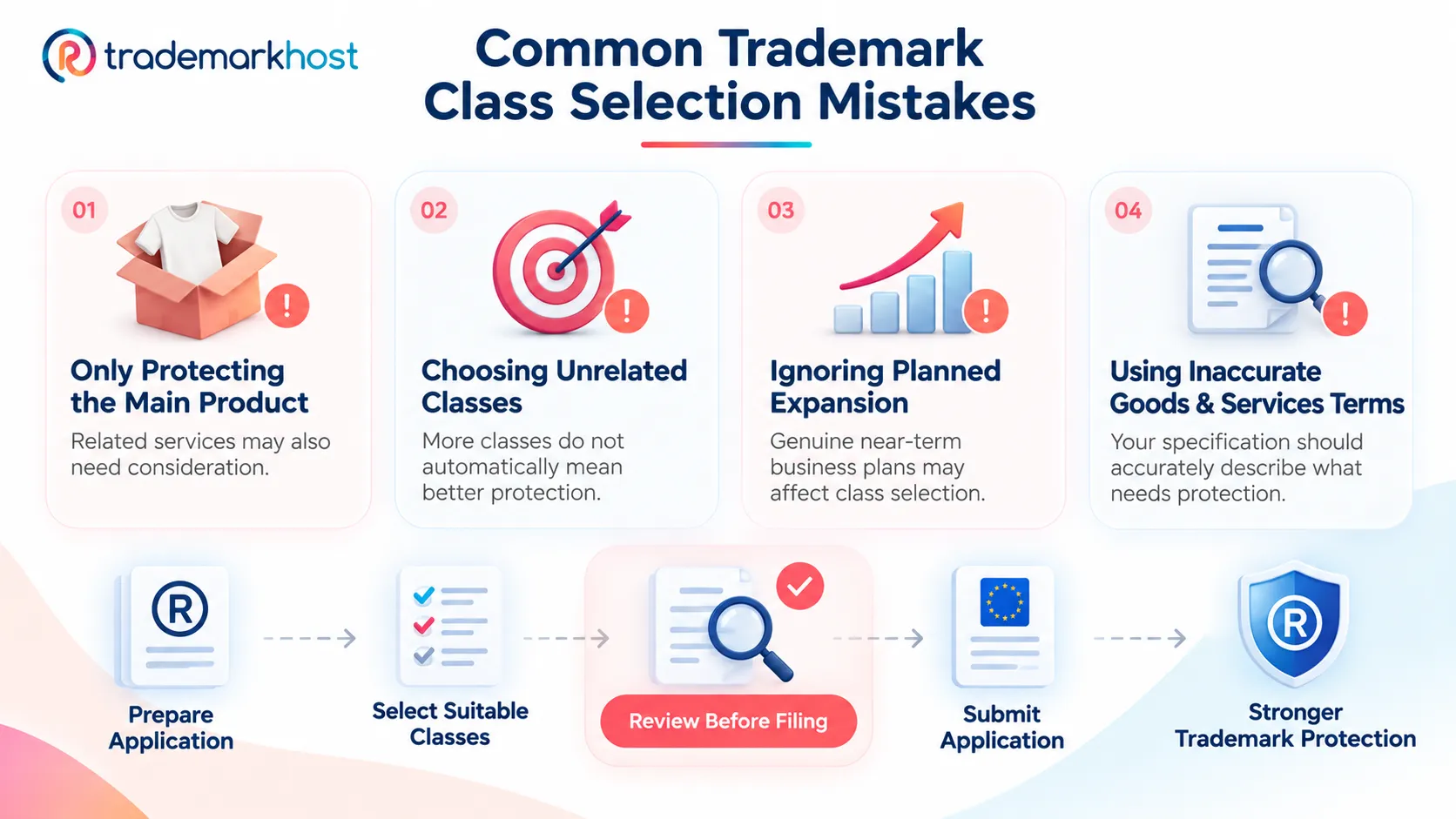
Common classification mistakes can leave important gaps in your trademark protection. Many businesses focus only on their finished products while overlooking related services. For example, a clothing business may need Class 25 for clothing and, if it provides retail services under the mark, may also need to consider Class 35.
Another critical mistake is failing to think ahead. Consider both your current offerings and genuine near-term expansion plans when selecting goods and services. While unnecessarily broad or purely speculative coverage should be avoided, planned business expansion may also be relevant to your filing strategy. If you are launching an organic food brand and have genuine plans to offer cooking classes (Class 41) or restaurant services (Class 43), those activities may also be worth considering when developing your filing strategy.
How Does TrademarkHost Help Businesses Select the Right Classes?

Selecting the appropriate EU trademark classes can be complex, but you don’t have to do it alone. TrademarkHost provides professional support for trademark registration in the European Union. We help clients identify appropriate classes, prepare specifications of goods and services, and support them throughout the application process.
Whether you are a startup filing your first application or an established brand expanding into new markets, TrademarkHost offers expert guidance on class selection, multi-class filing strategies, and ongoing brand monitoring. We work according to the laws and policies where your business is located or where you need protection, such as:
- European Union trade mark applications through EUIPO (European Union Intellectual Property Office)
- U.S. trademark applications through the USPTO (United States Patent and Trademark Office)
- China, the UAE, and Australia trademark processes according to their national offices
- International trademark filings through the Madrid System, administered by the World Intellectual Property Organization (WIPO)
We help businesses protect and manage their intellectual property as part of a broader brand strategy. From filing your EU trademark application to managing oppositions and renewals, TrademarkHost is your trusted partner at every stage of the trademark journey.
Conclusion
Selecting the appropriate EU trademark classes is an important part of building an effective brand protection strategy. Take the time to map your current offerings and plans carefully, use EUIPO’s TMclass tool to verify your terminology, and consider working with a trademark professional to help identify the appropriate classes and prepare an accurate application. At TrademarkHost, we provide professional trademark registration support for businesses seeking protection in the EU and other jurisdictions worldwide.
FAQs
How many EU trademark classes are there in total?
The Nice Classification contains 45 classes. Classes 1 to 34 cover goods, while Classes 35 to 45 cover services. EUIPO uses this classification for EU trade mark applications
Can I add more classes to my EU trademark application after filing?
No. After filing, you cannot broaden the list of goods and services covered by the application. You may only restrict its scope, which is why careful selection before filing is important.
How do EU trademark classes affect the registration cost?
The number of classes selected can affect the overall cost of EU trademark registration. The total cost depends on the services required and the specific requirements of your application.
What is the difference between EU trademark classes 41 and 42?
Class 41 covers education, training, entertainment, and cultural activities, while Class 42 covers scientific and technological services, IT, software development, and cloud-based services. Depending on their goods and services, some technology businesses may need to consider both classes.
Do I need to register in every class my business may use?
You should select classes that appropriately cover the goods and services for which you genuinely intend to use the mark. Avoid adding unrelated classes simply to obtain broader coverage.